From Ruins to Restored Building: The Story of The Premier Building-Hope Waddel Training Institution
March 31, 2025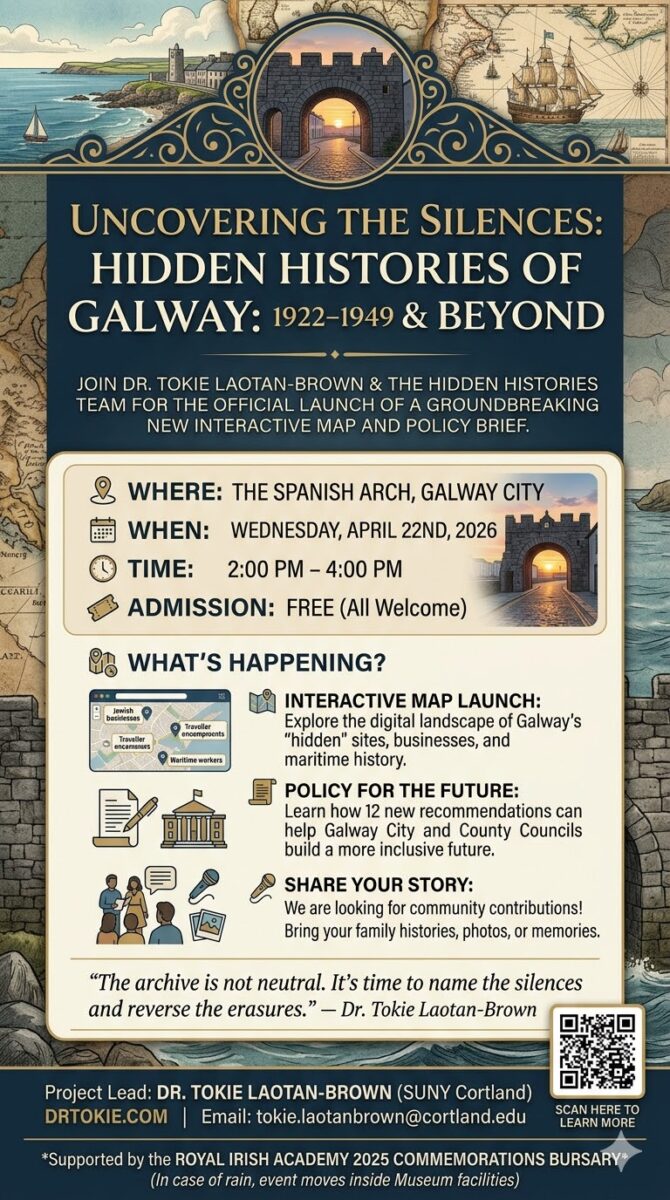
Galway. The name itself conjures up certain images. You think of colourful medieval streets. You hear the sound of trad music spilling from ancient pubs. You feel the wild Atlantic wind whipping across the bay.
The city is celebrated for its vibrant culture and storied past. That past is often defined by the legacy of the “Tribes of Galway.” These were the fourteen merchant families who dominated its political and commercial life for centuries.
But I was once a resident of this city. I learned that the most profound stories are often the ones you have to search for. They do not live in the well worn narratives of the powerful. They live in quiet corners. They live in forgotten ruins. They live in the memories of communities who have always been here. Yet these communities have often been written out of the central plot.
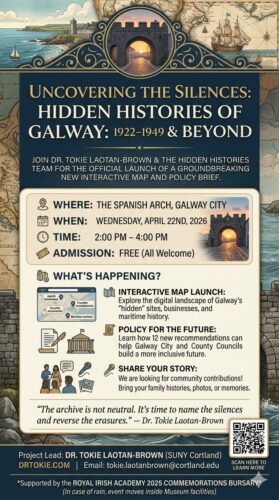
This post is an invitation. Let us journey beyond the familiar postcard. Let us uncover some of the hidden histories of Galway. These stories offer a richer portrait of the city. They offer a more complex portrait. They offer a more truthful portrait.
The First Gaeltacht Voice from Africa
In the early 20th century, a South African man named Osmond Tisani arrived in Galway. He achieved something remarkable. He is recorded as the first known person of African origin to learn and speak the Irish language of the Galway Gaeltacht.
His life story is pieced together from historical records. It is a fascinating tale of travel and service. It is a tale of cultural immersion. It challenges our assumptions about identity and belonging in Ireland a century ago.
Tisani’s presence serves as a powerful counter narrative. It challenges the idea of a single story of Irishness. More recently, the contemporary African diaspora in Galway has been documenting its own history. They are doing this through projects like Reverberate. This is an oral history initiative. It invites Black migrants to recount their journeys. It asks them to reflect on their relationship with the city.
These stories are both old and new. They are an integral part of Galway’s social fabric. Yet they are often overlooked.
The “Unknown Irishwomen” of Galway
History has a way of making women disappear. This is especially true of traditional history writing. Dr. Maureen Langan Egan’s work provides a poignant example. Her book is called Galway Women in the Nineteenth Century. It seeks to tell the stories of the “Unknown Irishwoman.” These are the women whose lives slide between the cracks. They are the ones who could easily be completely forgotten.
These were not just passive figures. Consider Alice Perry. In 1902 she began her studies at what is now the University of Galway. She became the first woman in Europe to earn a degree in engineering.
Consider Shamrock Trench. She was a trailblazer in aviation. At just twenty two years old, she became the first woman in Ireland to earn an “A” pilot’s license. This was in 1931.
And there are figures in the more intimate realm of community care. Consider Anne “Ma” Kilcommins. She was a respected local midwife. Her skill and dedication were trusted above all else. This was true even when she was not officially allowed to practice.
These women are just a few examples. They are the uncredited architects of Galway’s social history.
An Indelible Indigenous Minority: The Traveller Community
The history of Irish Travellers is deeply woven into the fabric of Ireland. References to a nomadic people stretch back as far as the 12th century. For generations they were a vital part of the rural economy. They worked as tinsmiths and seasonal labourers. They worked as horse traders. They were often welcomed for the essential services they provided.
The historic Ballinasloe Horse Fair remains a significant meeting point for the community today. It is one of Europe’s oldest fairs.
Yet their story is also one of profound marginalization. For centuries they have been separated from the settled population. This has led to widespread stereotyping. Genetic studies have shown an important fact. Travellers are of Irish ancestral origin. They likely diverged from the settled population as far back as the 1600s.
Today institutions like the University of Galway are working to preserve this heritage. They are creating new archives. These archives document the lived experiences and challenges of the Traveller community. Acknowledging this history is crucial. It helps us understand the full picture of Galway and Ireland.
Echoes of “Little Jerusalem” and a Forgotten Plague
The hidden history of Galway includes surprising chapters of migration. During World War II, an influx of Jewish people arrived in the west of Ireland. Many were connected to the hat factories in Galway and nearby Castlebar. The area around the Castlebar factory became known locally as “Little Jerusalem.”
The community was small. But its presence speaks to a wider story. It is the often forgotten story of Jewish life in Ireland. That story dates back to the 11th century. It saw renewed migration in the late 19th and early 20th centuries.
Darker chapters also lie just beneath the surface. The Great Famine is the defining tragedy of 19th century Ireland. But another catastrophe is less remembered. In 1649, a Spanish ship introduced the bubonic plague to Galway. The outbreak killed at least 3,700 inhabitants. It forced many more to abandon the city for a time. This disaster briefly but catastrophically reshaped urban life.
The Famine’s Shadow: Workhouses and Mass Emigration
No hidden history of Galway can ignore the Great Famine. The broad strokes are well known. But the local impact is truly harrowing. The Galway Workhouse became a site of immense suffering. During the peak years of 1847 and 1848, approximately 11,000 inmates died within its walls.
The situation was so dire that auxiliary workhouses had to be opened. They opened across the city to cope with the overwhelming need. On a single bitterly cold morning in January 1848, two children were found dead on High Street. They were found naked.
This cataclysm triggered a wave of emigration. It would forever alter the county’s demographic and cultural landscape. Between 1851 and 1914, over 229,000 people left Galway. This staggering number is almost certainly an underestimation.
The legacy of the Famine is found in many places. It is in the memorials. It is in the global Irish diaspora. It is in the empty fields. It is in the silent ruins of homes scattered across the Connemara landscape.
Preserving the Hidden Gems: From Ancient Forts to Sunken Secrets
As an architect, I am drawn to the physical traces of these hidden histories. I am drawn to the structures that survive as silent witnesses. Across County Galway there are countless hidden gems. They offer a more intimate connection to the past than any crowded tourist site.
Consider Clontuskert Priory. This is a little known 15th century religious ruin. It was founded on a site that may have housed a monastery as early as 800 AD. It yields ample pleasures for the traveller who troubles to find it.
Consider Fiddaun Castle. This is a remarkably preserved 16th century tower house. Its inner walls are incredibly intact.
And then there are the secrets held by the landscape itself. Recently a Bronze Age fortress was discovered hidden beneath a public park in the Burren lowlands. There are also 4,500 year old logboats lying forgotten at the bottom of Lough Corrib. They are slowly giving up their secrets to underwater archaeologists.
These are not just curiosities. They are vital pieces of our shared heritage. They remind us of an important truth. History is not a single finished narrative. It is a continuous process of discovery and documentation. It is a process of preservation.
Each new find transforms our knowledge of this place. A tidal weir complex is discovered off Barna. A forgotten holy well is found shrouded in mystery. Each discovery tells us more about the people who came before us.
A Personal Note
I lived in Galway for several years. During that time I was humbled to be recognized as one of the city’s most influential women. Galway is a city that gets into your bones. The past feels incredibly close here. You feel it walking the old Long Walk promenade. You feel it exploring the ruins of Menlo Castle on the banks of the Corrib.
My work has taught me an important lesson. We must actively look for the histories that are less visible. We must seek out the story of the Traveller. We must seek out the story of the migrant. We must seek out the story of the midwife and the workhouse orphan.
Their stories are the bedrock upon which modern Galway is built. By uncovering and sharing them, we do not just remember the past. We build a more inclusive understanding of our cultural heritage. We build a more authentic understanding for the future.