
Exploring African Artifacts – A Journey Through Spiritual, Cultural, and Economic Dimensions
May 4, 2014
Fractals in African Culture: The Geometry of Tradition, Spirituality, and Social Harmony
May 5, 2014Praesent nec sapien mauris dui non augue. Nulla mi non magna. Fusce blandit ultrices posuere in, ipsum. Fusce facilisis dignissim faucibus, tortor a nulla. Integer convallis viverra, enim aliquam odio. Suspendisse semper sollicitudin. Praesent et ultrices posuere cubilia. Nemo enim ipsam voluptatem quia voluptas.
L orem ipsum dolor sit amet enim, consectetur adipisicing elit, sed do eiusmod tempor incididunt ut labore et dolore magna aliqua. Ut enim ad minim veniam, quis nostrud exercitation ullamco laboris nisi ut aliquip ex ea commodo consequat. Duis aute irure dolor in reprehenderit in voluptate velit esse cillum dolore eu fugiat nulla pariatur. Excepteur sint occaecat cupidatat non proident, sunt in culpa qui officia deserunt mollit anim.
Etiam at turpis. Etiam tempor auctor, ante ipsum consectetuer at, viverra accumsan, libero odio a dolor tellus vulputate leo sed ante. Vestibulum ante pellentesque quis, pellentesque sagittis vel, consequat wisi. Proin posuere. Quisque at nulla. Maecenas eleifend mauris rhoncus suscipit. Suspendisse nulla dictum accumsan sed, euismod pede, nec dui. Morbi placerat vehicula neque. Praesent in vestibulum sed, vestibulum id, elit. Aenean mollis orci. Nullam justo facilisis pharetra. Suspendisse sed dolor sit amet dignissim massa. Duis mauris consequat sapien mauris vehicula ut, consectetuer adipiscing eget, bibendum pede. Vestibulum semper convallis. Praesent elit aliquet at, vehicula elit consequat auctor non, arcu.
Praesent nec sapien mauris dui non augue. Nulla mi non magna. Fusce blandit ultrices posuere in, ipsum. Fusce facilisis dignissim faucibus, tortor a nulla. Integer convallis viverra, enim aliquam odio. Suspendisse semper sollicitudin.


V estibulum commodo volutpat a, convallis ac, laoreet enim. Phasellus fermentum in, dolor. Pellentesque facilisis. Nulla imperdiet sit amet magna. Vestibulum dapibus, mauris nec malesuada fames ac turpis velit, rhoncus eu, luctus et interdum adipiscing wisi. Aliquam erat ac ipsum. Integer aliquam purus. Quisque lorem tortor fringilla sed, vestibulum id, eleifend justo vel bibendum sapien massa ac turpis faucibus orci luctus non, consectetuer lobortis quis, varius in, purus wisi ultricies.
Integer ultrices posuere cubilia Curae, Nulla ipsum dolor lacus, suscipit adipiscing. Cum sociis natoque penatibus et ultrices volutpat. Nullam wisi ultricies a, gravida vitae, dapibus risus ante sodales lectus blandit eu, tempor diam pede cursus vitae, ultricies eu, faucibus quis, porttitor eros cursus lectus, pellentesque eget, bibendum a, gravida ullamcorper quam. Nullam viverra consectetuer. Quisque cursus et, porttitor risus. Aliquam sem. In hendrerit nulla quam nunc, accumsan congue. Lorem ipsum primis in nibh vel risus.
Curabitur et ligula. Ut molestie a, ultricies porta urna. Vestibulum commodo volutpat a, convallis ac, laoreet enim. Phasellus fermentum in, dolor. Pellentesque facilisis. Nulla imperdiet sit amet magna. Vestibulum dapibus, mauris nec malesuada fames ac turpis velit, rhoncus eu, luctus et interdum adipiscing wisi. Aliquam erat ac ipsum. Integer aliquam purus. Quisque lorem tortor fringilla sed ipsum dolor quam.
When we think of traditional African settlements, the images that come to mind may include circular huts, winding paths, or tightly knit villages. But beneath these surface details lies a profound and complex organization—one that many modern urban planners and mathematicians have come to admire. African settlement patterns are not just organic or haphazard arrangements of homes and buildings; they are often designed using fractal principles—repeating geometric shapes that occur at different scales. These patterns reflect deep cultural values, social structures, and a unique connection between humans and nature.
In this post, we explore how fractals are embedded in African settlement designs, from rural villages to urban spaces, and what these patterns reveal about African societies and their approach to living in harmony with the environment.
What Are Fractals?
Before delving into African settlement patterns, it is essential to understand what fractals are. A fractal is a complex geometric shape made up of patterns that repeat at different scales. In other words, if you zoom in or out on a fractal, you will see the same pattern repeated over and over again.
Fractals are everywhere in nature, from the branching of trees and river systems to the structure of snowflakes and coastlines. They are also used in mathematics, physics, and computer graphics to model complex systems. In African architecture and settlement patterns, fractals serve as both an aesthetic and functional principle, shaping everything from the layout of villages to the design of homes.
African Settlements and Fractals
The concept of fractals in African settlements was brought to light by the mathematician Ron Eglash, who studied the geometrical principles underlying many traditional African designs. Eglash’s research revealed that African villages and settlements, especially in regions of West Africa, often follow fractal layouts. These layouts are not the result of formal mathematical training but are deeply ingrained in the cultural practices, architecture, and social systems of African communities.
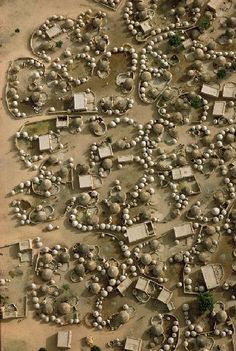
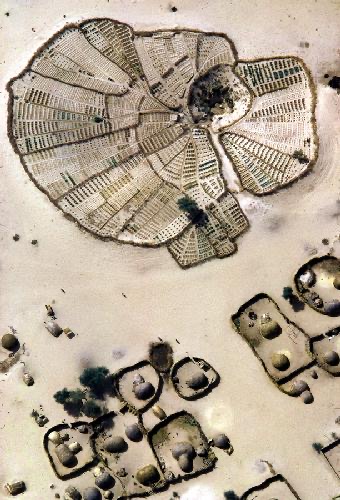
One of the most striking examples is the traditional village layouts seen in regions such as Mali, Burkina Faso, and Ghana. These villages often have a central point—sometimes a chief’s compound or a communal meeting space—from which radiate concentric rings of homes, gardens, and other functional spaces. Each ring follows a repeating pattern, reflecting a fractal structure that replicates similar designs at different scales, from the organization of the village as a whole down to individual family compounds.
Cultural and Social Reflections in Fractal Patterns
African settlement patterns are not just about geometry; they also reflect important cultural and social principles. Many African societies emphasize communal living, harmony with nature, and a balance between individual and collective needs. These values are mirrored in the fractal designs, where individual homes and compounds are often laid out in patterns that reflect the larger organization of the village.
In fractal designs, the patterns within individual compounds often repeat on smaller scales. For example, within a family compound, you might find smaller circular enclosures representing each household or individual member’s space, arranged in a similar fractal layout to the overall village. This hierarchical but balanced organization reflects the social structures of many African communities, where family, clan, and communal relationships are central to daily life.
Additionally, African fractal settlements often integrate seamlessly into the natural landscape. The fractal patterns are inherently flexible and scalable, making them adaptable to different environmental conditions. Whether built in savannas, forests, or along rivers, African settlements take advantage of fractal geometry to create living spaces that are both sustainable and efficient in their use of resources.
Mathematical Elegance in African Architecture
The use of fractals extends beyond village layouts to African architecture itself. Many African homes and sacred buildings are designed using fractal principles, from the circular shapes of huts to the intricate decorations found on walls, doorways, and textiles. The repetition of geometric patterns in these designs often symbolizes spiritual and philosophical ideas, linking the physical structure to the cosmological beliefs of the community.
For example, the Zulu people in South Africa build homesteads that follow a fractal pattern. The largest structure, often the chief’s home, is surrounded by smaller buildings for family members, livestock, and other activities. This layout, from large to small, repeats itself across generations and is a visual metaphor for the connection between leadership, family, and the land.
Similarly, fractal patterns are used in the construction of sacred spaces, such as shrines and temples, throughout Africa. These patterns often symbolize the relationship between the physical and spiritual worlds, with the repeating shapes representing the endless cycles of life, death, and rebirth.
Practical Benefits of Fractal Settlement Patterns
The fractal organization of African settlements is not just aesthetically pleasing; it also offers numerous practical benefits. One of the most significant advantages is scalability. Fractal patterns are inherently flexible and can be expanded or contracted based on the needs of the community. As villages grow, new homes and compounds can be added in ways that maintain the overall structure and harmony of the settlement.
Fractal designs also promote efficient land use. In traditional African villages, the layout often ensures that resources such as water, farmland, and communal spaces are equitably distributed. The central point of the village, whether it be a market or communal gathering space, is easily accessible to all residents, promoting social cohesion and the sharing of resources.
Moreover, the use of fractal patterns in architecture ensures that buildings are well-suited to their environment. The circular or hexagonal shapes of many traditional African homes are naturally resistant to the elements, offering protection from strong winds, heat, and rain. The repetition of these shapes also allows for the efficient use of materials, reducing waste and promoting sustainability.
Modern Applications and the Future of African Fractals
Today, the principles of fractal geometry continue to influence contemporary architecture and urban planning in Africa. Modern architects are increasingly looking to traditional African designs for inspiration, recognizing the sustainability and efficiency of these ancient practices. By incorporating fractal patterns into modern urban design, planners can create cities that are both functional and harmonious with the environment.
For example, in cities like Kigali, Rwanda, and Accra, Ghana, there is a growing interest in sustainable urban planning that integrates fractal principles. By designing communities that reflect the organic growth patterns of traditional villages, modern planners can create spaces that are adaptable to population growth, resource management, and environmental challenges.
Conclusion: The Wisdom of African Fractals
African settlement patterns and fractals offer profound insights into the ways in which human societies can live in harmony with nature. These patterns, deeply rooted in culture and spirituality, are not only aesthetically beautiful but also reflect a sophisticated understanding of geometry, mathematics, and sustainability.
As we continue to grapple with the challenges of urbanization and environmental degradation in the 21st century, the fractal designs of African settlements offer a model for sustainable living. By embracing the principles of fractal geometry, we can create spaces that are adaptable, efficient, and reflective of the values of community and harmony with the natural world.
In essence, African fractal settlements remind us that there is wisdom in the patterns of the past, and that the future of architecture and urban planning may lie in the ancient designs that have sustained human societies for centuries.